Introduction
For many professionals pursuing a Doctor of Business Administration, the most important stage of the program is the thesis or dissertation. While coursework helps develop advanced business knowledge and research skills, the dissertation is where students demonstrate their ability to solve a real business problem through structured research.
The Rushford DBA is designed for experienced professionals who want to combine academic learning with practical business application. Completing the dissertation requires careful planning, independent research, critical thinking, and the ability to present meaningful recommendations based on evidence.
If you are considering the Rushford DBA, understanding what the thesis and dissertation process involves can help you prepare for the journey ahead. This guide explains every stage of the dissertation, from selecting a topic to completing the final research project.
What Is the DBA Dissertation?
A DBA dissertation is an independent research project completed during the final stage of the doctoral program. It allows students to investigate a business challenge, analyse data, and provide practical solutions based on their findings.
Unlike many academic research projects that focus mainly on theory, a DBA dissertation is application-oriented. Students are expected to connect research with real business situations and produce work that can contribute to organisational improvement.
The dissertation demonstrates that a student can independently plan, conduct, and present doctoral-level research.
Why Is the Dissertation Important?
The dissertation is considered the most significant academic requirement of the DBA program because it brings together everything learned throughout the course.
It reflects a student’s understanding of business management, leadership, research methodology, analytical thinking, and problem-solving skills. Successfully completing the dissertation also shows that the student can identify business challenges and recommend practical strategies supported by research.
For many professionals, the dissertation becomes a valuable addition to their academic and professional profile.
Choosing the Right Research Topic
Selecting an appropriate research topic is the first major step in the dissertation process.
Students are encouraged to choose a topic related to their industry, profession, or business experience. Working on a familiar area makes research more meaningful and allows students to apply their professional knowledge throughout the study.
A good research topic should be relevant, practical, researchable, and capable of providing valuable insights for organisations.
Some common research areas include:
- Business Strategy
- Leadership
- Marketing Management
- Human Resource Management
- Financial Management
- Business Analytics
- Digital Transformation
- Supply Chain Management
- Organisational Behaviour
- Entrepreneurship
- Innovation Management
- Sustainability
Choosing a topic that genuinely interests you also helps maintain motivation throughout the research journey.
Developing the Research Proposal
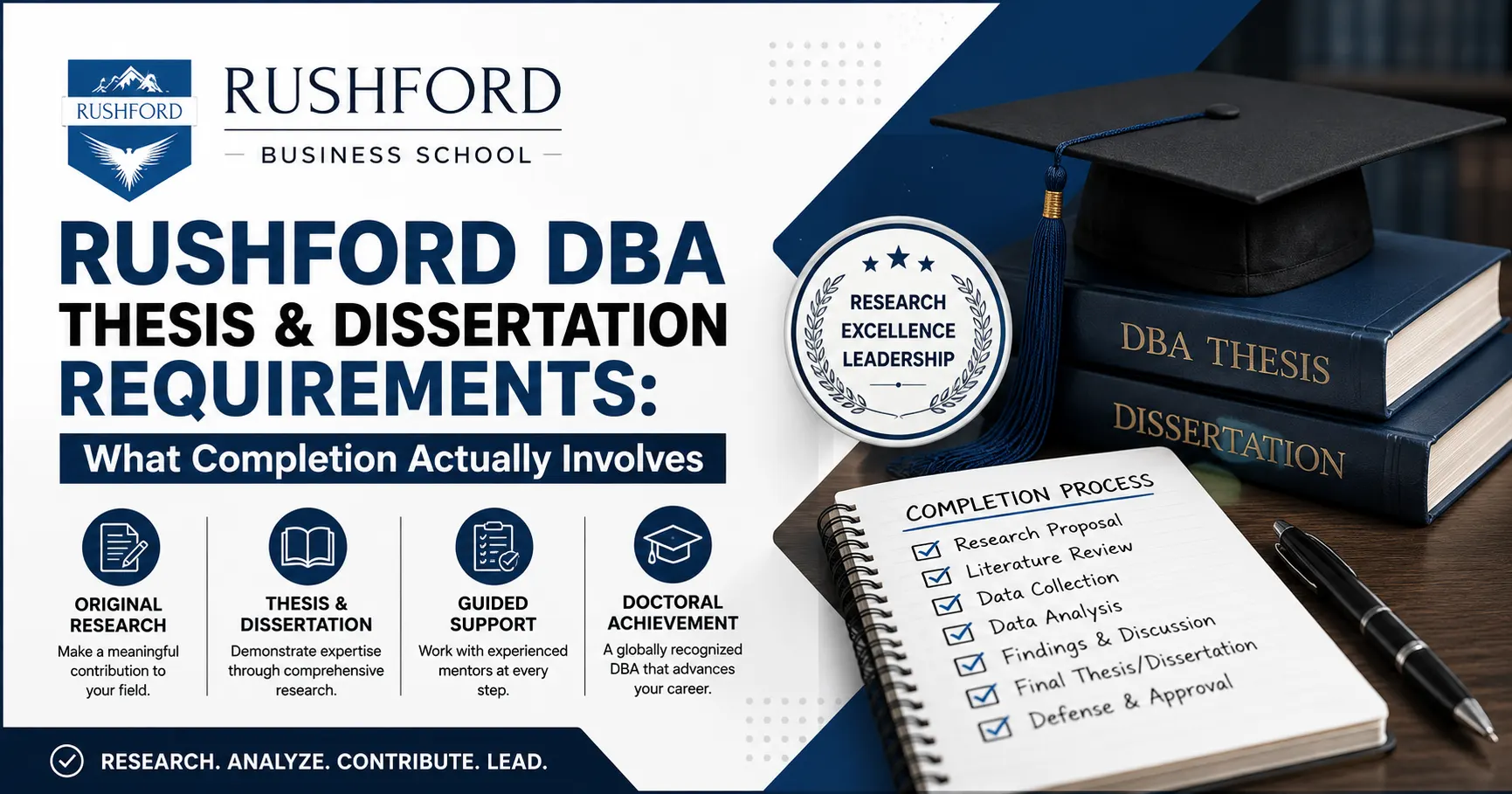
Before beginning the dissertation, students prepare a research proposal.
The proposal serves as a blueprint for the entire research project. It explains what the student plans to study, why the topic is important, and how the research will be conducted.
A research proposal generally includes:
| Section | Purpose |
|---|---|
| Research Title | Defines the topic |
| Introduction | Explains the background of the study |
| Research Problem | Identifies the business issue |
| Objectives | States the goals of the research |
| Research Questions | Defines what the study will answer |
| Literature Review | Reviews existing knowledge |
| Research Methodology | Explains how data will be collected |
| Expected Outcomes | Describes the anticipated contribution |
A well-prepared proposal provides clear direction for the remaining stages of the dissertation.
Conducting the Literature Review
The literature review is one of the most detailed sections of the dissertation.
Students examine books, journals, research papers, industry reports, and other academic resources related to their chosen topic. The objective is to understand existing research, identify knowledge gaps, and establish the foundation for the new study.
Instead of simply summarising previous work, students critically evaluate different viewpoints and explain how their own research will contribute to the field.
A strong literature review demonstrates academic depth and supports the overall quality of the dissertation.
Designing the Research Methodology
The research methodology explains how the study will be carried out.
Students select appropriate research methods based on the nature of their topic and research objectives. Depending on the study, the methodology may involve qualitative research, quantitative research, or a combination of both.
The methodology chapter usually discusses:
- Research design
- Data collection methods
- Sampling techniques
- Research tools
- Data analysis methods
- Ethical considerations
Choosing the right methodology is essential because it directly affects the reliability and accuracy of the research findings.
Collecting and Analysing Data
Once the proposal and methodology are finalised, students begin collecting data.
Information may be gathered through surveys, interviews, questionnaires, case studies, organisational records, or other appropriate sources depending on the research topic.
After data collection, students organise and analyse the information carefully to identify trends, patterns, relationships, and insights that answer the research questions.
The findings should be objective, accurate, and supported by evidence.
Writing the Dissertation
Writing the dissertation is a gradual process that requires consistency and careful planning.
Although the structure may differ slightly depending on the research topic, a typical dissertation includes:
| Chapter | Description |
|---|---|
| Introduction | Background, objectives, and research questions |
| Literature Review | Analysis of previous research |
| Research Methodology | Research methods and study design |
| Data Analysis | Presentation of research findings |
| Discussion | Interpretation of the results |
| Recommendations | Practical business suggestions |
| Conclusion | Summary of the overall research |
Each chapter should connect logically with the next, creating a clear and well-organised research document.
Guidance Throughout the Dissertation
Completing a doctoral dissertation is a lengthy process, and students usually receive academic guidance throughout the program.
Supervisors help students refine their research topic, improve their proposal, review chapter drafts, and provide feedback on research quality. Their guidance ensures that students remain focused on their objectives and maintain academic standards throughout the project.
Regular communication with supervisors can make the dissertation process more organised and manageable.
Final Evaluation
After completing the dissertation, students submit the final research document for academic evaluation.
The assessment focuses on several important aspects, including:
- Originality of the research
- Quality of data analysis
- Practical relevance
- Academic writing
- Research methodology
- Overall contribution to business knowledge
Students may also be required to explain and defend their research before successfully completing the doctoral program.
Challenges Students May Face
Writing a DBA dissertation requires dedication and effective time management.
Working professionals often balance full-time jobs, family responsibilities, and academic commitments simultaneously. Managing research deadlines while maintaining professional responsibilities can be challenging.
Other common challenges include selecting the right research topic, collecting quality data, analysing complex information, and maintaining consistency throughout the writing process.
Planning each stage carefully can help overcome these challenges.
Tips for Successfully Completing the Dissertation
Students can improve their chances of success by following a structured approach throughout the program.
Start working on your research topic early and choose an area that matches your professional experience. Maintain a realistic writing schedule and complete small sections regularly instead of waiting until the final months.
Read academic literature consistently to strengthen your understanding of the subject. Accept feedback from your supervisor and revise each chapter carefully before moving to the next stage.
Finally, review the complete dissertation thoroughly to ensure clarity, consistency, and accuracy before submission.
Career Benefits After Completing the Dissertation
Completing a DBA dissertation demonstrates advanced research capability and strategic thinking.
Graduates may qualify for leadership positions in corporate organisations, consulting firms, educational institutions, multinational companies, and entrepreneurial ventures.
The research experience also strengthens decision-making, analytical thinking, business problem-solving, and leadership abilities that are highly valued in senior management roles.
For many professionals, completing the dissertation becomes an important milestone in their career development.
Conclusion
The dissertation is the most important stage of the Rushford DBA journey. It allows students to apply advanced business knowledge to real organisational challenges while developing strong research and analytical skills.
From selecting a meaningful research topic to preparing the final dissertation, every stage requires careful planning, discipline, and continuous learning. Although the process demands significant effort, it also provides valuable professional and academic growth.
For working professionals who want to strengthen their expertise and contribute meaningful business research, successfully completing the dissertation is a rewarding achievement that can support long-term career advancement.
Frequently Asked Questions
1. Is the dissertation compulsory in the Rushford DBA?
Yes, completing a dissertation is an essential requirement for earning the DBA degree.
2. Can I choose my own dissertation topic?
Yes, students generally select a research topic based on their professional interests and business experience.
3. How long does it take to complete the dissertation?
The duration depends on individual progress, research complexity, and the time required for writing and revisions.
4. Will I receive guidance during the dissertation?
Yes, students typically receive academic supervision and feedback throughout the research and writing process.
5. What skills does the dissertation help develop?
The dissertation strengthens research, analytical thinking, leadership, business problem-solving, academic writing, and strategic decision-making skills.